How to Calculate Food Cost Percentage (With a Real Example)
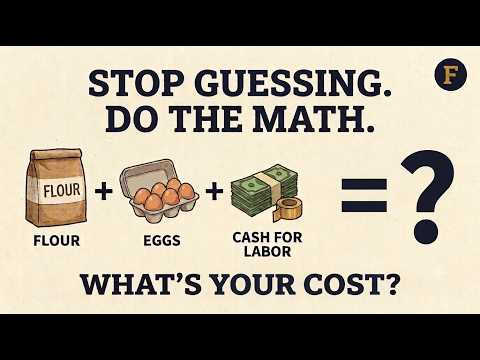
Food cost percentage is the share of your menu price that goes to ingredients. It's the first number every restaurant, food truck, and market stand should know for every item they sell. Most don't, because nobody hands you this when you get the keys.
Food cost % = ingredient cost per portion ÷ menu price × 100
The math is simple. Getting the ingredient cost right is where people go wrong, so that's where most of this guide goes.
Step 1: Cost one portion, not one package
You don't sell a bag of flour. You sell a burrito that uses a few ounces of it. So every ingredient has to be broken down to what one portion actually uses.
- Take the price you paid from your most recent invoice or receipt.
- Divide it by the package size to get a cost per unit (per ounce, per gram, per each).
- Multiply by the amount one portion uses.
Example: a 5 lb bag of shredded cheddar costs $24.00. That's 80 oz, so $0.30 per ounce. If a burrito gets 1 oz, the cheese in it costs $0.30, not $24.
Step 2: Add it up for one item
Here's a breakfast burrito costed the same way, with example numbers:
| Ingredient | Amount per burrito | Cost |
|---|---|---|
| Flour tortilla, 12" | 1 each | $0.28 |
| Eggs, large | 2 each | $0.50 |
| Potatoes, diced | 3 oz | $0.22 |
| Cheddar, shredded | 1 oz | $0.30 |
| Breakfast sausage | 2 oz | $0.55 |
| Salsa | 1 oz | $0.12 |
| Ingredient cost | $1.97 |
At a menu price of $9.00, the food cost percentage is $1.97 ÷ $9.00 × 100 = 21.9%.
Step 3: Read the number like an operator
Many restaurants aim for an overall food cost somewhere around 28 to 35 percent, but the right target depends on your concept, your prices, and your other costs. Individual items will land all over the place. Coffee and fountain drinks run low. Steaks and seafood run high.
Don't chase one magic number. Use food cost to compare items against each other and against your overall target. The questions it answers are practical: which items carry the menu, which ones need a price change, and which ones are popular but quietly losing ground.
Food cost isn't your true cost
Ingredients are only part of what an item costs you. Add what the plate can't go out without:
- Packaging: foil, a clamshell, a napkin. Say $0.15.
- Card fees: around 3% of the price, so $0.27 on a $9.00 burrito.
Now the burrito costs $2.39 before rent, labor, or paying yourself, which is 26.6% of the price instead of 21.9%. That gap is why a lot of busy food businesses are still broke. The menu pricing guide shows how to set prices that cover it.
Three mistakes that throw the number off
- Costing the package instead of the portion. Counting a whole $4 bag of chocolate chips when the recipe uses half of it roughly doubles that ingredient's cost. It's the most common error, and it's the same one AI tools make if you don't check them.
- Using old prices. Costs from last year's invoices make today's margins look better than they are. Re-cost when your supplier prices move, or at least every quarter.
- Ignoring yield loss. Potatoes get peeled, meat loses weight when it cooks, and some produce gets trimmed. If you buy 10 lb and serve 8 lb, cost it on the 8.
Do it by hand once, then build it to run
Cost your best seller by hand this week. Once you've done one, a costing spreadsheet can do the rest of your menu and reprice everything when an ingredient goes up.
The video version of this lesson walks through a full example by hand, including where an AI tool gets it wrong. If you'd rather do it with your own numbers and someone next to you, apply for a free 30-minute session or see restaurant consulting.